
On this page
- What is hospital pharmacy management software?
- Where hospital pharmacies struggle
- Features that matter in hospital pharmacy software
- 1. Prescription import from the HMIS
- 2. Salt and generic awareness at the counter
- 3. Batch, expiry and rack location
- 4. IPD charges on the patient's running bill
- 5. GST and HSN that match your filings
- 6. Purchase and distributor management
- 7. Returns and refunds without stock leaks
- 8. Payments and split tender
- 9. Audit trail and role-based access
- 10. Reports an owner reads
- The pharmacy is not the hospital store
- Questions to ask in a pharmacy software demo
- Standalone pharmacy or part of the suite?
- See your pharmacy counter running
- Frequently asked questions
- What is hospital pharmacy management software?
- Can Tapti Pharmacy run without Tapti HMIS?
- Does it import prescriptions from the doctor?
- How are batches and expiries handled?
- Do IPD medicines go on the patient's hospital bill?
- Is pharmacy billing GST compliant?
- Which package includes Tapti Pharmacy?
A hospital pharmacy is three businesses in one room. It is a retail counter for OPD patients, a supplier to the wards for admitted patients, and a stock room full of batches that expire on a schedule.
Run it on a generic billing tool and every one of those jobs suffers. The counter re-types prescriptions. Ward medicines reach the patient's bill late, or not at all. Expired strips are found when the auditor finds them.
This guide explains what pharmacy management software for a hospital should do, where hospital pharmacies usually struggle, and what to test in a demo. If you want to see the product first, visit Tapti Pharmacy.
What is hospital pharmacy management software?
Hospital pharmacy software manages the full medicine cycle inside a hospital: buying from distributors, holding stock by batch and expiry, selling at the counter, supplying admitted patients, handling returns and producing the tax records your accountant needs.
The difference from a retail chemist package is the hospital link. In a hospital, the prescription is written in the OPD or on the ward. The patient may be admitted, so medicines belong on the IPD bill, not a separate cash memo. The pharmacy has to talk to the rest of the hospital.
Where hospital pharmacies struggle
The same problems show up again and again:
Re-typed prescriptions. The doctor writes one thing, the counter keys in another. Spellings, strengths and quantities drift.
Brand-only stock lookup. The prescribed brand is out of stock, and the staff cannot quickly see what else carries the same composition.
Expiry surprises. Near-expiry stock is not visible until it is too late to return or sell.
IPD medicines off the bill. Ward supplies are written on paper and reconciled at discharge, if at all.
GST at month end. Purchase and sale tax splits are rebuilt by hand for the CA.
Untraceable stock changes. An adjustment or refund happened, but nobody knows who did it or why.
Each one is a software problem with a software answer.
Features that matter in hospital pharmacy software
1. Prescription import from the HMIS
This is the feature that separates hospital pharmacy software from a retail POS. The doctor writes the prescription once, and the pharmacy pulls it.
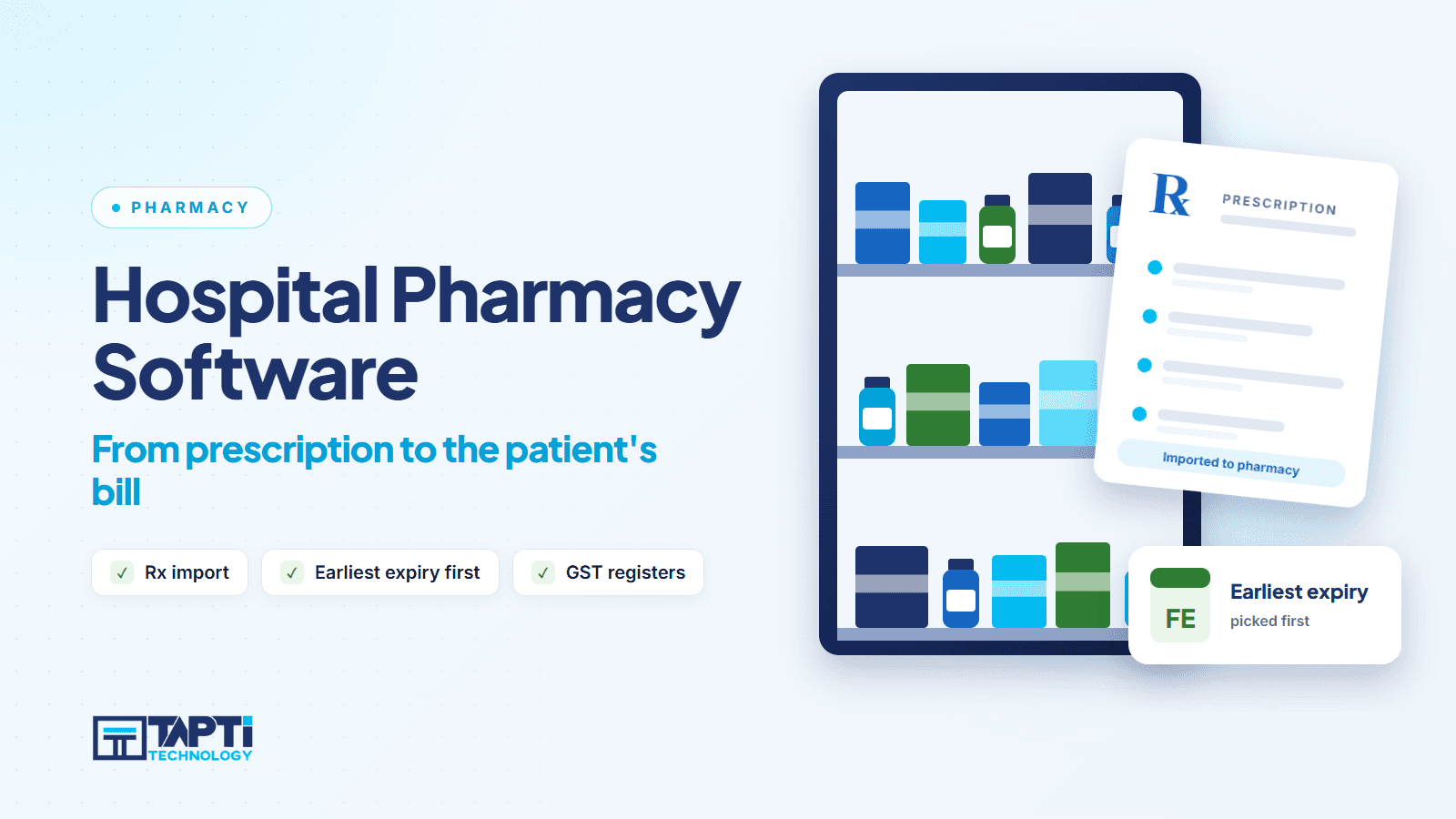
In Tapti Pharmacy, prescriptions are pulled from the Tapti HMIS prescription queue in one click. The system suggests salt-to-brand substitutions, fills the quantity from days and frequency, and carries the patient and doctor through to the invoice. The status goes back to the OPD or IPD screen, so the clinical side knows the prescription was dispensed.
2. Salt and generic awareness at the counter
When a branded prescription arrives and that brand is not on the shelf, staff need to see in-stock alternatives with the same composition. Tapti Pharmacy links the item master to a salt and generic master, so the counter sees matching alternatives for substitution and out-of-stock situations.
3. Batch, expiry and rack location
Every strip should belong to a batch. In Tapti Pharmacy, every purchase line creates or appends to a batch with manufacture date, expiry and rack location. Sales pick from the oldest expiry first (FEFO) by default. Near-expiry and low-stock alerts warn the team early, and expiry-bucket and dead-stock reports show what to sell, return to the vendor or write off.
4. IPD charges on the patient's running bill
For admitted patients, pharmacy charges must land on the IPD bill. When Tapti Pharmacy is connected to Tapti HMIS, IPD pharmacy charges post directly to the patient's running bill, so there is no double entry and no end-of-day reconciliation. The discharge summary picks up the pharmacy lines. On the clinical side, the IPD module records medicine management, medication errors and adverse drug reactions on the patient's file.
5. GST and HSN that match your filings
Indian pharmacy billing is GST-heavy. Look for HSN or SAC codes and GST slabs on every item, the correct CGST, SGST or IGST split on every invoice, and tax registers your CA can work with. Tapti Pharmacy does all of this, with GST R1 and R3B-friendly tax registers.
6. Purchase and distributor management
Stock starts with the distributor bill. Tapti Pharmacy keeps a distributor master with credit-period tracking, splits GST line by line on purchases, auto-creates the item or batch from the purchase line, and calculates margin from MRP against landed cost. Purchase returns to distributors generate a credit note.
7. Returns and refunds without stock leaks
Patients return unused strips. In Tapti Pharmacy, partial or full sale returns are made against the original bill, refunds go to the original tender or store credit, stock is reversed to the original batch, and a GST credit note is generated. Reason codes are captured for audit.
8. Payments and split tender
The counter needs cash, UPI and card, and sometimes a split across them. Tapti Pharmacy supports all of these, with a GST and HSN-correct invoice printed on every bill.
9. Audit trail and role-based access
Every stock adjustment, refund and write-off in Tapti Pharmacy writes to an audit trail with user, timestamp, and before and after values. Role-based access controls who can refund, who can adjust stock and who can view margins.
10. Reports an owner reads
At month end, the questions are always the same: what sold, what is expiring, who do we owe. Tapti Pharmacy reports cover daily sale and collection, salt-wise and generic-wise movement, expiry buckets, dead stock, tax registers, and vendor outstanding with ageing.
The pharmacy is not the hospital store
Hospitals often mix up two different stock problems. The pharmacy sells and dispenses medicines to patients. The hospital store supplies consumables such as gloves and surgical items to wards and the OT.
Tapti treats them separately. Tapti Pharmacy runs the medicine counter and IPD dispensing. The inventory module in Tapti HMIS runs the store: store departments and item masters, indents raised by wards, an approval step, purchase orders, goods received and purchase payments, with printed indents and POs for audit.
When you evaluate software, ask which of the two each screen is solving.
Questions to ask in a pharmacy software demo
Ask the vendor to show these live, on their own system:
☐ Write a prescription in the OPD and pull it into the pharmacy without re-typing.
☐ Ask for a brand that is out of stock and show the same-salt alternatives.
☐ Sell a strip and show which batch it came from and why.
☐ Show the near-expiry list for the next few months.
☐ Dispense to an admitted patient and show the charge on the IPD bill.
☐ Return half a strip against an old bill and show the stock and credit note.
☐ Enter a distributor bill with mixed GST rates.
☐ Show the tax register you would hand to your CA.
☐ Show who adjusted stock last week, and what changed.
Anything that needs "we will customise it" is not in the product today.
Standalone pharmacy or part of the suite?
Tapti Pharmacy runs both ways. As standalone software it covers a retail chemist or pharmacy with its own masters, sale, purchase and reporting. Alongside Tapti HMIS, prescription import, patient sync and IPD-side billing come into play.
On pricing, Pharmacy is available as a standalone module starting at ₹5,000 a year for up to 3 users. For hospitals, Tapti Pharmacy is bundled only in the Full Suite, which starts at ₹15,000 a year for hospitals up to 15 beds and also includes OPD, IPD, lab, inventory, surgery and mediclaim. With other packages, Tapti Pharmacy can be added as a sister product. Above 15 beds, we quote to your setup, and hospitals above 100 beds get a custom quote. Tapti HMIS serves hospitals from 5 beds to 400+ beds.
For the full pricing logic, read HMIS software price in India. If you are planning a full hospital rollout, our 30-bed hospital software checklist covers pharmacy alongside every other department.
See your pharmacy counter running
Bring a few real prescriptions (with patient details removed) and your trickiest distributor bill. We will run them through Tapti Pharmacy and Tapti HMIS live. Book your free demo.
Frequently asked questions
What is hospital pharmacy management software?
It is software that runs a hospital's medicine cycle: purchase, batch and expiry stock, counter sales, supply to admitted patients, returns and GST records, linked to the hospital's prescriptions and bills.
Can Tapti Pharmacy run without Tapti HMIS?
Yes. Tapti Pharmacy works as standalone retail pharmacy software. When deployed alongside Tapti HMIS, prescription import, patient sync and IPD-side billing come into play.
Does it import prescriptions from the doctor?
Yes, when connected to Tapti HMIS. The pharmacy pulls the prescription from the HMIS queue, gets salt-to-brand suggestions and quantity filled from days and frequency, and the status goes back to the OPD or IPD screen.
How are batches and expiries handled?
Each purchase line creates or appends to a batch with manufacture date, expiry and rack location. Sales pick the oldest expiry first, and near-expiry, dead-stock and expiry-bucket reports flag stock early.
Do IPD medicines go on the patient's hospital bill?
Yes. With Tapti HMIS connected, IPD pharmacy charges post directly to the patient's running bill.
Is pharmacy billing GST compliant?
Every item carries its HSN or SAC code and GST slab, every invoice prints the CGST, SGST or IGST split, and the tax registers map to GST R1 and R3B filings.
Which package includes Tapti Pharmacy?
Pharmacy is available as a standalone module starting at ₹5,000 a year for up to 3 users, and is bundled only in the Full Suite. With other packages it can be added as a sister product.