
On this page
- Why there is no single price
- How bed-tier pricing works
- Tapti's public starting prices
- What a bigger tier buys you
- The costs outside the licence
- Annual subscription vs one-time licence
- How to compare quotes properly
- Does software pay for itself?
- Get a number for your hospital
- Frequently asked questions
- What is the price of HMIS software in India?
- Why is HMIS priced by bed count?
- Is pharmacy included in the HMIS price?
- Is ABDM extra?
- Is WhatsApp integration included?
- What does a 100-bed hospital pay?
- Are there costs beyond the licence?
"How much does hospital software cost?" is the first question every buyer asks and the last one most vendors answer clearly. This post fixes that. It explains how HMIS pricing works in India, what drives the number up or down, and where the hidden costs sit.
We will use Tapti's public starting prices as worked examples. They are anchors, not a final quote, and we say so clearly below.
Why there is no single price
An HMIS is not a product with a sticker price like a phone. Three variables move the number:
Bed capacity. More beds means more admissions, more billing, more users and more support.
Modules. OPD alone is a lighter product than OPD, IPD, lab, pharmacy, inventory, surgery and mediclaim together.
Deployment and services. Cloud or on-premise, data migration, training, and paid add-ons.
Any vendor who gives you a flat price without asking your bed count and modules is either hiding something or selling something too small.
How bed-tier pricing works
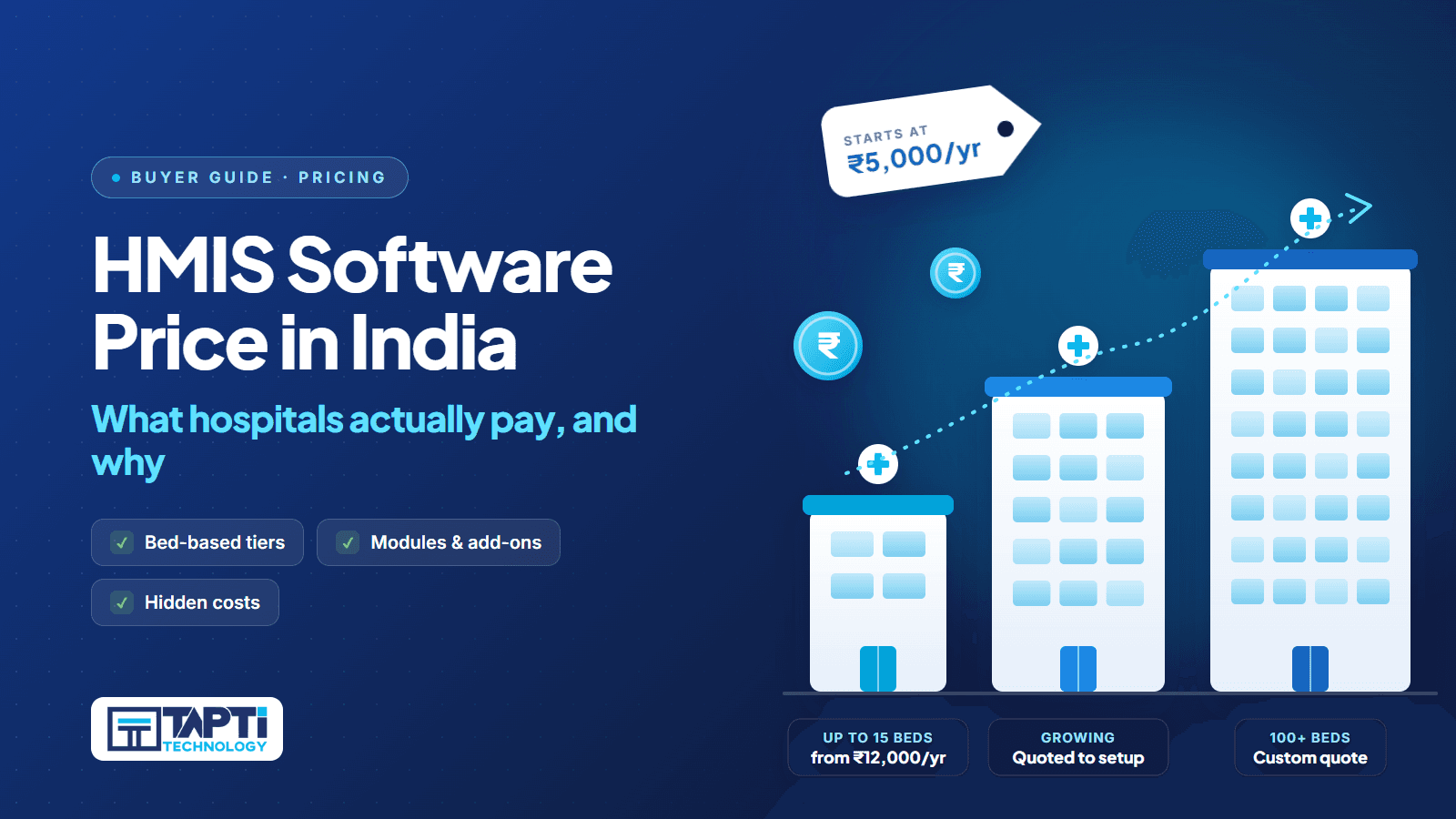
Many Indian HMIS vendors price by bed capacity, in tiers. The logic is simple: bed count is the cleanest proxy for how heavily a hospital uses the system. A 10-bed nursing home generates a fraction of the transactions of a 90-bed hospital. Tiering lets a small hospital pay for small usage instead of subsidising enterprise features.
A typical structure looks like this:
Small hospitals: a low entry price for a defined bed ceiling.
Mid-size hospitals: a higher tier per band of beds, quoted to the setup.
Large hospitals (100+ beds): custom quotes, because staff counts, departments and integrations vary too much for a fixed rate card.
At Tapti, pricing is tiered by bed capacity. Hospitals above the entry tier are quoted to their setup, and 100+ bed hospitals receive custom quotes.
Tapti's public starting prices
These are the starting points published on our website. They are per year.
| Package | Starting price | Who it suits |
|---|---|---|
| Standalone Modules | ₹5,000/yr | One module (OPD, Laboratory or Pharmacy) for solo practitioners, diagnostic centres and standalone pharmacies. Up to 3 users. |
| OPD + IPD | ₹12,000/yr | Small hospitals up to 15 beds, with no lab or pharmacy yet. |
| Full Suite | ₹15,000/yr | IPD + OPD + Lab + Pharmacy, every module, for hospitals up to 15 beds. |
Above 15 beds, we quote to your setup.
A few notes that save you confusion:
"Starting from" means starting from. These are the entry prices. Your final quote depends on your bed count and the modules you need.
Pharmacy is bundled only in the Full Suite. With other packages, Tapti Pharmacy can be added as a sister product.
ABDM is included in the Standalone Modules, OPD + IPD and Full Suite packages.
WhatsApp Business integration is always a paid add-on. It is never bundled in any package.
What a bigger tier buys you
Moving up a tier is not just a number. It reflects scope. A hospital with 15-plus beds is typically running more of these:
IPD with admissions, bed shifting, deposits and automatic daily room charges
Surgery and OT scheduling
Inventory and store with indents, purchase orders and approvals
Mediclaim and TPA cashless workflows
Doctor revenue sharing across employed and visiting doctors
Reports for doctor-wise, department-wise and outstanding tracking
That scope is why we quote above 15 beds instead of printing a rate card. Two 40-bed hospitals can have very different needs.
The costs outside the licence
The licence is rarely the whole bill. When you compare quotes, put each of these in a column:
| Cost | What to ask |
|---|---|
| Implementation and setup | Is it included, or charged separately? |
| Data migration | How are existing patient and billing records brought in, and who does it? |
| Training | How many sessions, for which roles, and are printed guides included? |
| Hosting | Cloud managed by the vendor, or your own server? Who pays for backups? |
| Add-ons | WhatsApp, SMS, extra users, extra branches |
| Support | Is support tracked in a ticket system, and is it part of the annual price? |
| Renewal | What does year two look like? |
| Customisation | What is configurable by you, and what needs paid development? |
For context on what a Tapti rollout includes: patient bulk import from Excel is built in, and the team supports custom migration plans for billing history and master data. Onboarding includes role-based staff training, printed reference guides and a built-in support ticket system. Cloud deployments are managed by Tapti with daily backups, and on-premise is available too. The team works from Surat, Gujarat and is willing to do on-site implementation and training anywhere in India; confirm the terms for your location in the quote.
Annual subscription vs one-time licence
Two models exist in India:
Annual subscription: a lower upfront cost, predictable renewal. The Tapti anchors above are annual prices.
One-time licence plus annual maintenance: a larger cheque upfront, then a yearly maintenance fee. Check carefully what maintenance covers.
For a small hospital, subscription usually wins on cash flow. For a larger hospital with its own IT team, a licence can make sense. Either way, compare the three-year total, not the year-one figure.
How to compare quotes properly
Give every vendor the same brief. Same bed count, same modules, same number of users.
Get it in writing, including add-ons and the year-two price.
Compare modules, not just totals. A cheaper quote that omits billing or mediclaim is not cheaper.
Ask about the unit economics of growth. What happens to price when you add 10 beds or a second branch?
Ask what is not included. The answer tells you more than the brochure.
Does software pay for itself?
Software cost should be read against leakage it removes: room charges that never got billed, claims rejected for avoidable errors, doctor shares disputed at month end, stock that ran out. We cover this in our five-year ROI guide. The point is that a licence is a small line next to a year of recovered missed charges, and a large one next to a system your staff abandon.
Get a number for your hospital
Tell us your bed count and the modules you run, and we will send a written quote after a short demo. Book a free demo. To see how the products fit together, start with our HMIS software for India overview.
Frequently asked questions
What is the price of HMIS software in India?
It varies by bed capacity and modules. Tapti's public starting prices are ₹5,000 a year for a standalone module, ₹12,000 a year for OPD + IPD and ₹15,000 a year for the Full Suite, all for smaller setups. Above 15 beds, pricing is quoted to your setup.
Why is HMIS priced by bed count?
Bed count is the simplest measure of how much a hospital uses the system. Tiering keeps small hospitals from paying for capacity they do not need.
Is pharmacy included in the HMIS price?
At Tapti, Tapti Pharmacy is bundled only in the Full Suite. For other packages it can be added as a sister product.
Is ABDM extra?
No. At Tapti, ABDM is included in the Standalone Modules, OPD + IPD and Full Suite packages.
Is WhatsApp integration included?
No. WhatsApp Business integration is always a paid add-on at Tapti.
What does a 100-bed hospital pay?
Hospitals with 100+ beds receive custom quotes, because departments, users and integrations vary too widely for a fixed price.
Are there costs beyond the licence?
Usually: migration, training, hosting and add-ons. Ask each vendor to list them in writing before you compare totals.