
On this page
If you've been on three HMIS demos and each vendor called their software something slightly different — HMIS, HIS, EMR, HMS, EHR — you're not imagining it. The industry uses these acronyms interchangeably, and that's actively unhelpful when you're trying to buy the right thing.
Here is the plain-English version. By the end you'll know which one you actually need.
The 30-second version
| Acronym | What it stands for | What it does |
|---|---|---|
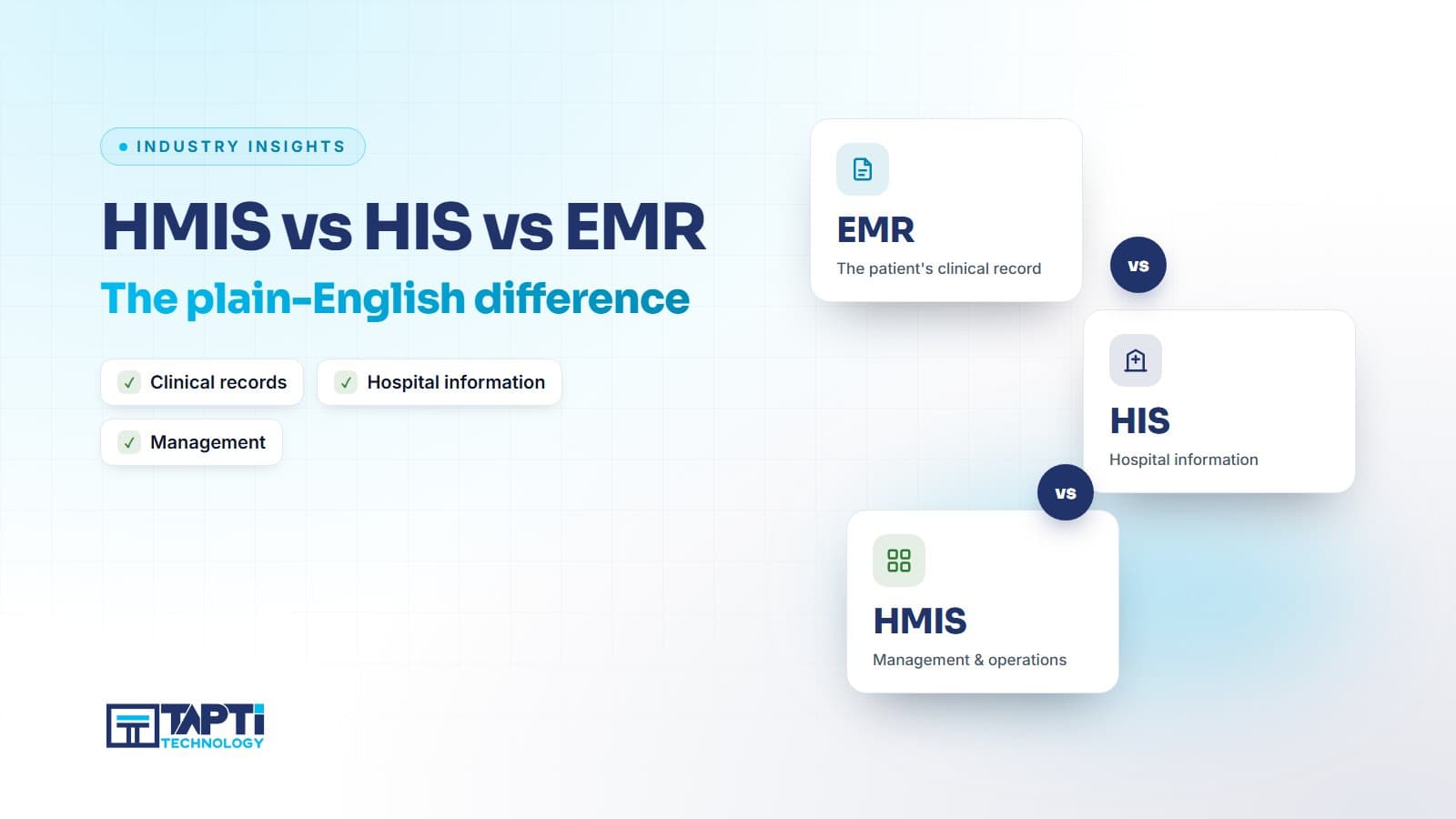
| EMR | Electronic Medical Records | Stores a patient's clinical record — notes, prescriptions, lab reports |
| HIS | Hospital Information System | Manages clinical operations — OPD, IPD, lab, surgery |
| HMIS | Hospital Management Information System | Manages everything — clinical plus billing, inventory, HR, reports |
| EHR | Electronic Health Records | Like EMR, but designed to follow the patient across hospitals |
The short answer: most Indian hospitals from 10 to 100 beds need an HMIS — the broadest of the four — because they cannot afford to run three different systems for clinical, billing, and operations.
EMR — the clinical record
An Electronic Medical Record (EMR) is the digital version of a patient's paper file inside one hospital. It contains:
- Demographic and contact information
- Visit history (OPD consultations, IPD admissions)
- Doctor's notes
- Prescriptions
- Lab and imaging reports
- Allergies, vitals, history
That's it. An EMR doesn't bill the patient, doesn't manage pharmacy inventory, doesn't schedule surgeries.
If you ran a single-doctor clinic that only needed digital notes, an EMR alone might be enough. For a hospital with admissions, billing, lab, and pharmacy — it isn't.
HIS — clinical operations
A Hospital Information System (HIS) does the EMR job plus the clinical operations that surround it:
- OPD registration and queueing
- IPD admission, transfer, discharge (ADT)
- Lab order entry, result entry, reporting
- Surgery scheduling and operating theatre management
- Nursing notes, drug administration records
- Bed management
HIS is what large hospitals in the West typically use, often paired with a separate billing system, a separate inventory system, and a separate accounting system. Three or four pieces of software, integrated.
This split makes sense if you're a 600-bed teaching hospital with 50 IT staff. It does not make sense for an Indian 30-bed hospital where the receptionist is the cashier is the data entry operator.
HMIS — the Indian hospital reality
A Hospital Management Information System (HMIS) is what HIS becomes when you assume the hospital cannot afford three integrated systems. It bundles:
- Everything an EMR has
- Everything an HIS has
- Plus: billing, pharmacy, inventory, HR/payroll, accounting links, mediclaim/TPA, doctor sharing, reports
This is the dominant model in Indian hospital software for a reason: it works at every scale from a 10-bed nursing home to a 100-bed multi-specialty. One vendor, one login, one support line, one bill at the end of the month.
The trade-off is that some modules are inevitably weaker than a best-of-breed standalone. An HMIS's HR module is rarely as deep as a dedicated HR system. Its accounting integration is rarely as deep as Tally. That's fine — for most hospitals, "good enough and integrated" beats "best-of-breed and disconnected."
EHR — the network-level version
An Electronic Health Record (EHR) is the EMR, but designed to follow the patient between hospitals. The patient's record exists at a level above any single hospital — they carry it with them.
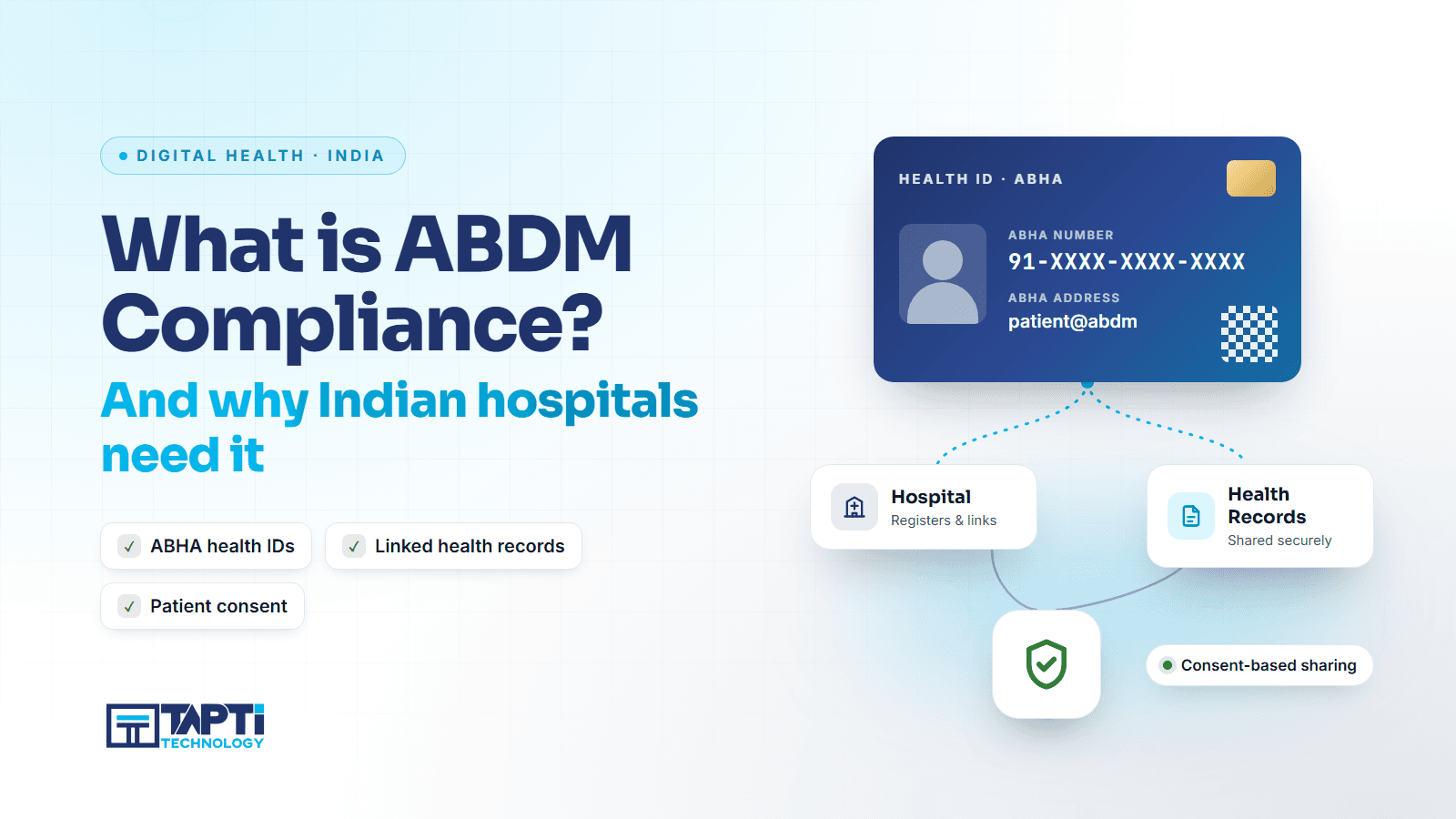
This is exactly what ABDM is doing in India. Through ABDM, the patient's records (created in your HMIS) become part of a network-level EHR they can carry to any other ABDM-connected provider via their ABHA number.
So in the Indian context:
An ABDM-compliant HMIS = your hospital's HMIS and its contribution to the national EHR layer.
Your HMIS handles your hospital. ABDM handles the national EHR. They work together — which is why "ABDM-compliant HMIS" is what you actually want to buy, not separate pieces.
What about "HMS"?
You'll sometimes see vendors use "HMS" instead of "HMIS." They mean the same thing in practice — Hospital Management System. The "I" for "Information" got dropped somewhere because it didn't add meaning. Don't read anything into the difference.
So which one do you actually need?
For an Indian hospital between 5 and 100+ beds:
- You need an HMIS. Not an EMR alone (too narrow), not an HIS alone (no billing), not a pure EHR (not a product, it's the layer your HMIS connects into).
- It must be ABDM-compliant. Without that, you're disconnected from the national network — which insurers, government schemes, and patients increasingly expect.
- It should bundle clinical, billing, lab, and reports as defaults. Add-ons like pharmacy, WhatsApp messaging, or specialty modules are reasonable to be paid separately. But the core HMIS shouldn't nickel-and-dime you for OPD, IPD, and lab.
A common mistake we see: hospitals buy a cheap "EMR" thinking it's an HMIS, only to discover at billing time that they need a second product. Or they buy a heavy enterprise HIS that doesn't bundle billing, then add a separate billing system — and the data never quite syncs.
The Indian sweet spot is and has been a tightly integrated HMIS with ABDM built in.
What Tapti HMIS is
Tapti HMIS is — yes, exactly that — a Hospital Management Information System for Indian hospitals, with ABDM compliance built into the core flows. It covers OPD, IPD (19 sub-modules), lab, surgery, billing, pharmacy, inventory, mediclaim/TPA, and reports. One platform, one vendor, one support line.
If you're trying to figure out what to buy, the pricing page shows what's bundled by bed-tier — no asterisks. And a 30-minute walkthrough is the fastest way to see whether the workflow density fits your hospital.