
On this page
The first question an Indian hospital owner asks when looking at HMIS software isn't "is it good?" — it's "is it worth it?"
That's the right question. Here's the answer, in plain rupees, for a typical 30-bed hospital running on paper today.
The four places paper costs you money every single day
Most owners look at the HMIS subscription price and stop there. They miss what paper actually costs them — quietly, daily, for years.
- Lost OPD billing — When the receptionist writes a referral fee on a slip and a doctor sees the patient without it reaching billing, that visit walks out unbilled. At an average ₹400/visit and ~6 leaks per week, that's ₹1.2 lakh / year.
- Pharmacy leakage — Medicines issued to an inpatient that never make it to the discharge bill. Even at a 1.5% leak on a small in-house pharmacy, that's ₹2–3 lakh / year.
- TPA rejections — Mediclaim claims rejected because the discharge summary missed a code, a vital, or a signature. Hospitals report 15–25% rejection rates on paper. A clean HMIS gets that under 5%.
- Inventory shrinkage — Expired stock, mis-counted consumables, unrecorded sample collection. At 2% of inventory turnover, this is the silent killer.
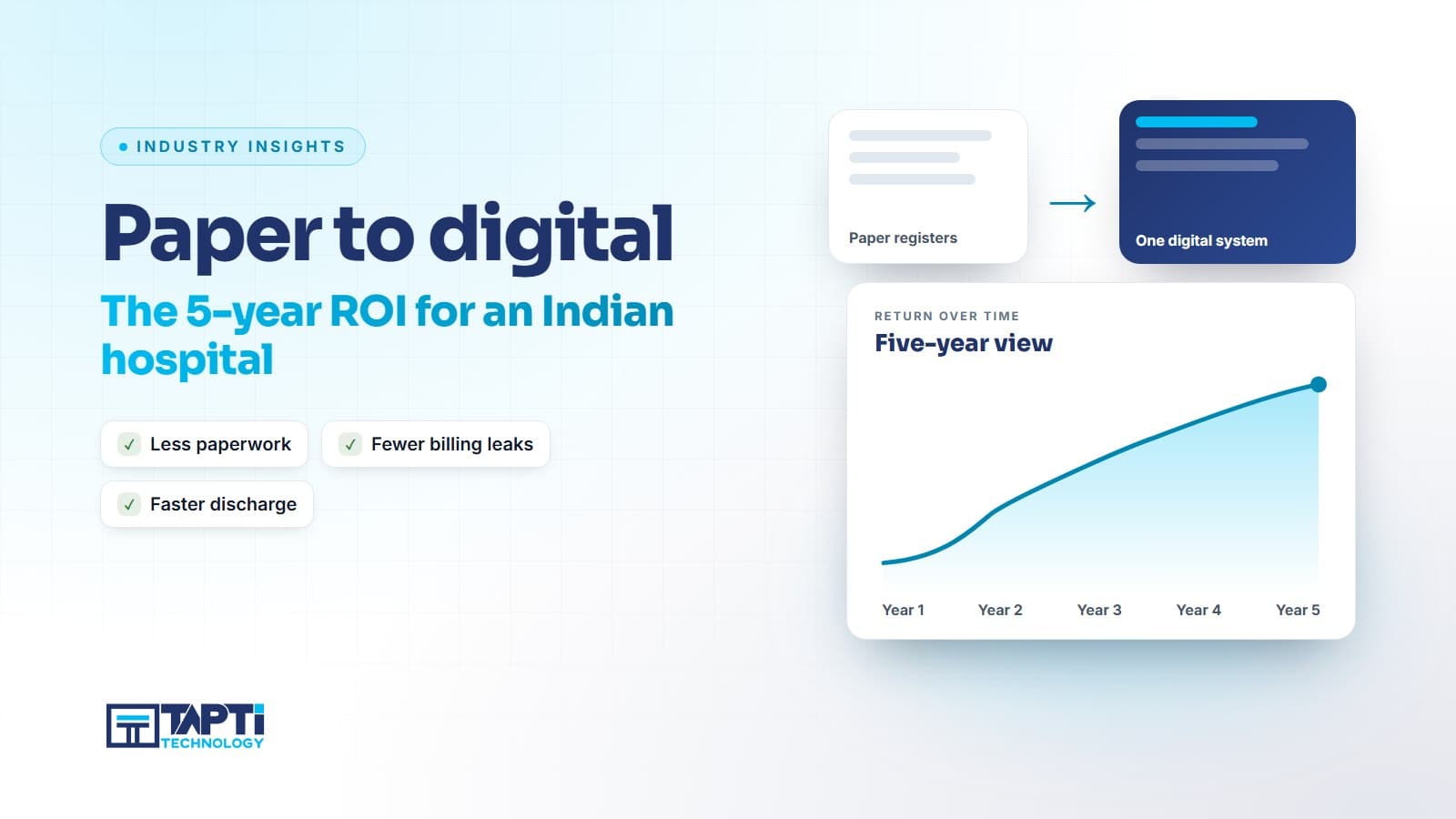
Add it up. On a 30-bed hospital doing modest numbers, the all-in cost of paper is comfortably ₹8–12 lakh per year. Year after year.
What an HMIS subscription actually costs
For comparison, a modern Indian HMIS for 30 beds — with ABDM compliance, OPD, IPD, lab, billing, and reports bundled — runs a small fraction of that annual leakage figure. The math isn't subtle.
The decision isn't "buy HMIS vs save money." It's "buy HMIS and save money."
The first six months matter most
Most of the ROI comes in the first 180 days, from three changes:
- Every OPD slot generates a billed entry. No leakage.
- IPD discharge can't happen without a finalised bill. No leakage.
- Pharmacy issues are deducted from inventory in real-time. No leakage.
By month seven, you start seeing the slower wins: TPA cycle time shrinks, reports get done in minutes instead of days, your CA stops complaining about reconciliation.
What hospitals tell us, six months in
"We didn't appreciate how much we were losing until we started seeing the numbers in dashboards. The system pays for itself by month four."
This is the most common feedback from hospitals onboarding to Tapti HMIS. The savings are already in your hospital — paper just hides them.
How to think about it
If you've been running on paper for years, you've effectively already paid for an HMIS — many times over — in leaked revenue. The only question is when you stop paying for it.
Want to see what your hospital's numbers would look like on Tapti? Book a 20-minute walkthrough — we'll model the savings for your specific bed-size and case mix.