
On this page
- What doctor revenue sharing means
- What it should never be
- Why spreadsheets cause disputes
- What good sharing software does
- Sharing profiles, set once
- Calculated from the bills already raised
- Save, review, then finalise
- Payments with a full history
- How it works in Tapti HMIS
- Questions to ask any HMIS vendor
- Frequently asked questions
- Is doctor revenue sharing allowed in India?
- Can a sharing calculation be locked?
- Is there a payment history for each doctor?
- Which Tapti package includes Doctor Sharing?
- See it with your own numbers
Walk into almost any Indian hospital and you will find a spreadsheet on someone's desk. It holds what each consultant is due for the month: consultations, procedures, surgeries and visits.
That spreadsheet is usually out of date and questioned at the end of every month. Not because anyone is careless, but because it lives outside the system that raised the bills. The figures are typed in twice, and each copy drifts.
Doctor revenue sharing is a normal part of how hospitals work with their consultants. This guide explains what it should cover, what it should not, and how software can make it accurate and calm.
What doctor revenue sharing means
Revenue sharing is how a hospital pays doctors for the clinical work they do on its patients. It usually takes two forms:
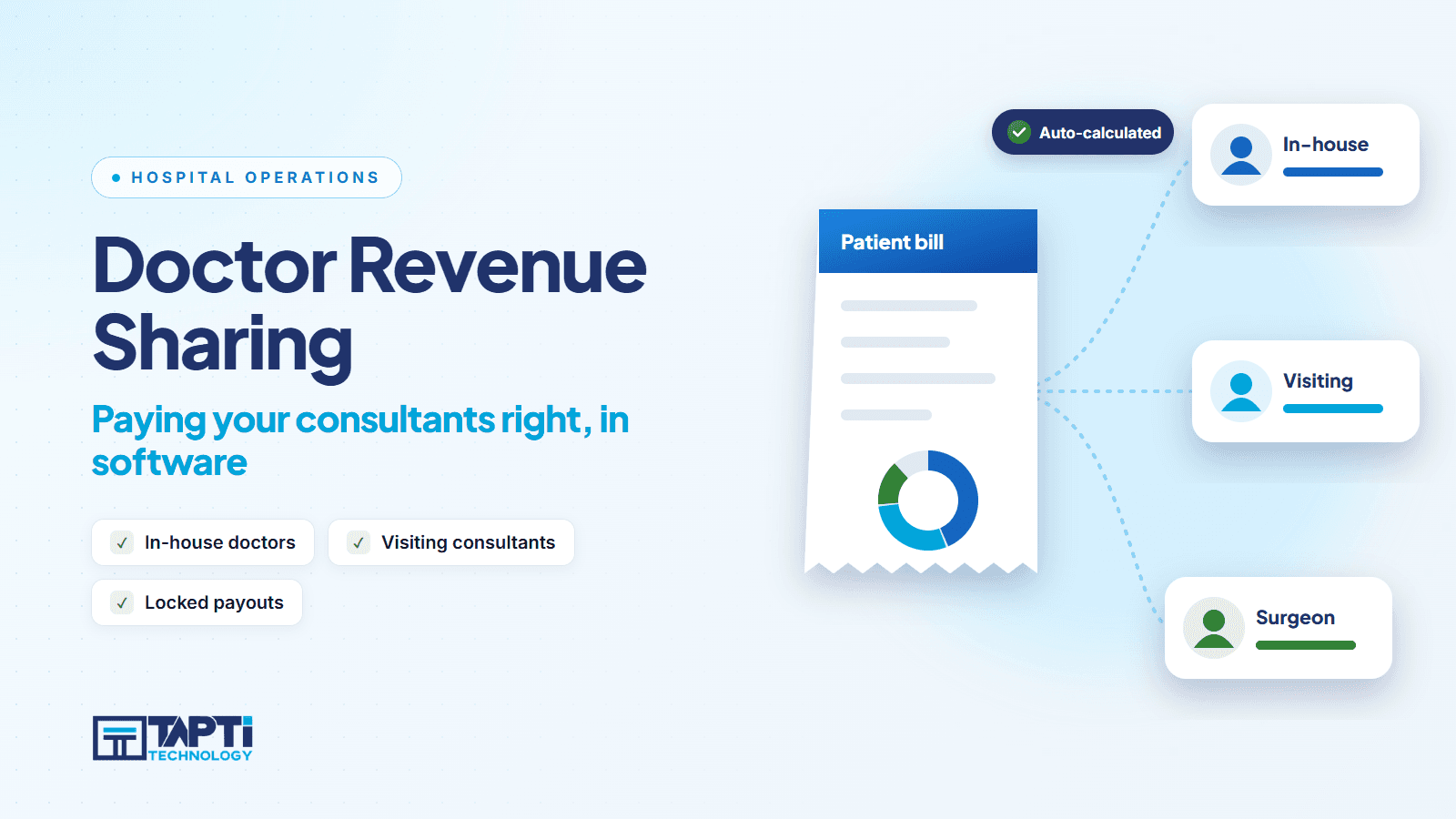
In-house doctors. Doctors who work at the hospital receive a share of the consultations, procedures and visits they personally perform, on terms agreed with the hospital.
Visiting consultants. Specialists who use the hospital's facilities for their patients receive their professional fee, and the hospital keeps its share for rooms, nursing, theatre and equipment.
In both cases the doctor is paid for work they actually did, at rates written into an agreement.
What it should never be
India's medical ethics rules, set by the NMC, do not allow doctors to give or accept any payment or gift for referring patients. A payment made only because a patient was sent to the hospital, with no clinical work behind it, is not revenue sharing. It is the "cut practice" that regulators, insurers and patients rightly object to.
A good rule of thumb: every rupee shared should map to a service on the patient's bill that the doctor performed. Have your sharing agreements reviewed by your legal adviser, and keep them in writing.
Software helps here too. When sharing is calculated from the bill, line by line, it is visible, consistent and easy to audit.
Why spreadsheets cause disputes
Rates change in a conversation and never reach the sheet
A procedure is missed because it was billed under a different head
Month-end reconciliation takes accounts staff days, not minutes
The doctor's count and the hospital's count never quite match
Nobody can say who changed a figure, or when
Each of these is a data problem, not a people problem. Fix where the data comes from, and most disputes disappear.
What good sharing software does
Sharing profiles, set once
The agreed terms for each doctor are configured once, as a sharing profile, and applied consistently to every bill. When terms change, the profile changes, and the history shows it.
Calculated from the bills already raised
The calculation should run on the invoices that are already in the system. No re-typing, no second copy. If a bill is correct, the share is correct.
Save, review, then finalise
Accounts should be able to run a calculation, save it, reset it if something changes, and finalise it only when it is agreed. Once finalised, the figure is locked, so what the doctor approved is what gets paid.
Payments with a full history
Every payment is recorded against the doctor, with a complete history. When a consultant asks about last March, the answer is on screen, not in an inbox.
How it works in Tapti HMIS
The Doctor Sharing module in Tapti HMIS covers this end to end:
Internal doctor sharing among the hospital's own doctors
Sharing profiles configured once and applied consistently
Save, reset and finalise workflow, so figures are locked before payment
Payment processing and history for every doctor
Because the calculation runs on the hospital's own invoices, it connects directly to billing, OPD and IPD, and the reports show what has been finalised and paid. Doctor Sharing is part of the Full Suite.
Questions to ask any HMIS vendor
Is sharing calculated from the actual bills, or entered separately?
Can terms be set per doctor, once, and reused?
Can a calculation be reviewed and locked before payment?
Is there a payment history per doctor?
Can accounts see which bill lines make up each doctor's share?
If the answer to the first question is "entered separately", you are buying a nicer spreadsheet.
Frequently asked questions
Is doctor revenue sharing allowed in India?
Paying doctors for clinical work they perform, under a written agreement, is standard practice in Indian hospitals. A payment made only for referring a patient is not allowed for doctors under NMC ethics rules. Have your agreements reviewed by your legal adviser.
Can a sharing calculation be locked?
Yes. In Tapti HMIS a calculation can be saved, reset and finalised, and payments are made against the finalised figure.
Is there a payment history for each doctor?
Yes. Every sharing payment is recorded with a full history per doctor.
Which Tapti package includes Doctor Sharing?
Doctor Sharing is included in the Full Suite. See pricing for how packages work.
See it with your own numbers
Bring one month of consultant terms to a demo and we will show you how the calculation, finalise and payment steps look in Tapti HMIS. Book a free demo.