
On this page
- What ABDM actually is
- The four things that actually matter
- 1. Issue or link ABHA numbers at registration
- 2. Become a Health Information Provider (HIP)
- 3. Optionally become a Health Information User (HIU)
- 4. Pass NHA's sandbox verification
- "Sandbox-verified" vs "production-live": know the difference
- What compliance does not require
- The real-world hospital impact
- A realistic compliance timeline
- What to ask your HMIS vendor
- The bottom line
If you run an Indian hospital, the word ABDM has probably shown up in a vendor email, a National Health Authority circular, or a conversation with your IT person. And somewhere between the acronyms — ABHA, HIE-CM, HIP, HIU, FHIR — the actual question got lost:
What does ABDM compliance mean for my hospital, and how do I get there?
This article answers that without the jargon. By the end you'll understand the four things that actually matter, what "sandbox-verified" really means, and what a realistic path to compliance looks like for a 20–60 bed hospital.
What ABDM actually is
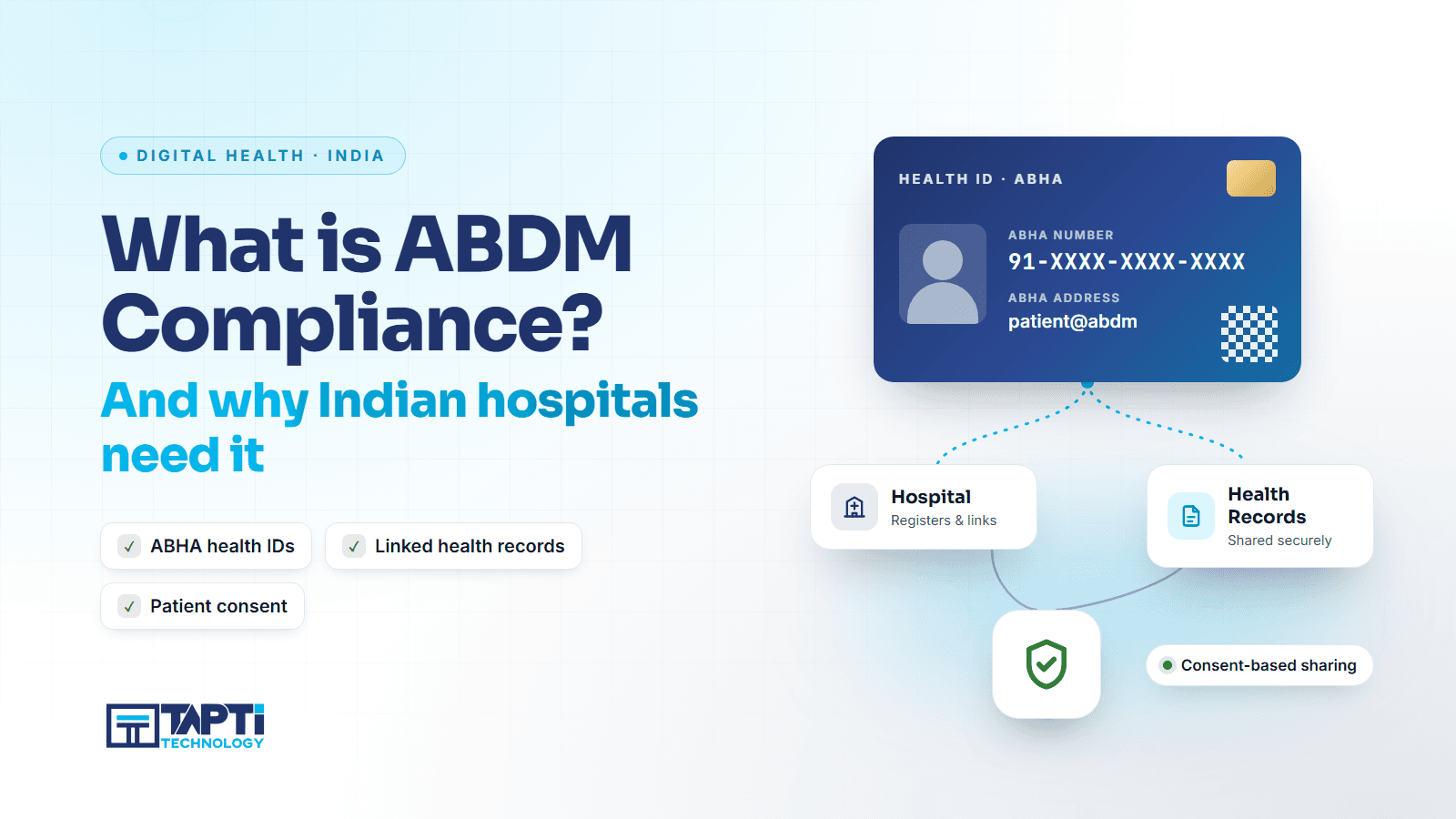
ABDM stands for Ayushman Bharat Digital Mission. It is the National Health Authority (NHA)'s programme to build a country-wide healthcare interoperability layer — think UPI, but for health records.
It does not replace your HMIS. It does not replace your billing system. It is not software you buy.
ABDM is a set of standards and rails that lets:
- Patients carry a single national health ID (ABHA) across hospitals, labs, pharmacies, and clinics
- Hospitals exchange clinical records electronically with patient consent
- Insurers, government schemes, and care providers plug into the same data layer
Your hospital becomes "ABDM compliant" by integrating its existing software with these rails — most commonly through your HMIS.
The four things that actually matter
Strip away the acronyms and ABDM compliance boils down to four things your hospital needs to do:
1. Issue or link ABHA numbers at registration
Every patient who walks in should be able to:
- Create a new ABHA number on the spot if they don't have one
- Link their existing ABHA at registration via OTP
This sits inside your OPD registration flow — not a separate desk, not a paper form. If your front-desk staff can't do it in the same screen where they enter the patient's phone number, your compliance is on paper, not in practice.
2. Become a Health Information Provider (HIP)
Your hospital generates records — discharge summaries, prescriptions, lab reports, OP consultation notes. As an HIP, you make these records available to the patient (and only the patient) through the ABDM network.
This is the heavy-lifting part. Your HMIS must:
- Generate clinical records in FHIR R4 format (the international standard)
- Bundle them as a Health Record with proper metadata
- Respond to consent requests from other providers
- Be discoverable on the HIE-CM (Health Information Exchange and Consent Manager)
3. Optionally become a Health Information User (HIU)
If your hospital wants to receive records — for example, a referred patient's history from a previous hospital — you also register as a Health Information User. Most small and mid-sized hospitals start as HIP-only and add HIU later.
4. Pass NHA's sandbox verification
Before going live in production, every integration must be tested in the NHA's ABDM Sandbox. The sandbox runs a fixed set of test cases against your integration. Pass them, and you get production credentials.
This is what "ABDM Sandbox-verified" means on a vendor's website. It is not optional — you cannot connect to the production network without it.
"Sandbox-verified" vs "production-live": know the difference
Many vendors advertise "ABDM compliant" or "ABDM ready." Ask one question:
"Is your integration verified against the NHA's ABDM Sandbox, and do you have production HIP/HIU credentials?"
Three honest answers exist:
| Answer | What it means |
|---|---|
| Yes, sandbox-verified, production-live | You can go live in days. Real ABDM. |
| Yes, sandbox-verified, production pending | Days away from live. Usually fine. |
| "We are building it / on the roadmap" | Not compliant. Months away at best. |
Tapti HMIS is verified against the NHA's ABDM Sandbox specifications. Hospitals onboarding to ABDM through Tapti get their HIP setup in days, not quarters.
What compliance does not require
Three things get over-sold by some vendors:
- You do NOT need to migrate every old patient record into ABDM. ABDM works on a forward-looking basis — new visits generate ABDM-shaped records. Historical records stay where they are.
- You do NOT need a separate "ABDM module" as an add-on. A well-built modern HMIS embeds ABDM into the existing OPD, IPD, and discharge flows. If a vendor is selling you ABDM as a ₹X / month add-on on top of an HMIS, ask why.
- You do NOT need to hire a new "ABDM coordinator." Your existing reception, billing, and discharge staff already touch every workflow ABDM affects. They just need a clear button in the screen they already use.
The real-world hospital impact
In a hospital that's actually live on ABDM, here's what changes:
- At reception: Patient phone number → ABHA OTP → patient identified. Two extra clicks. No new forms.
- At discharge: Discharge summary auto-generated in FHIR. Patient gets it on their ABHA app instantly.
- At lab: Reports get attached to the patient's ABHA. No more "where is my report" calls.
- At follow-up: Patient walks into another doctor's clinic, that doctor requests records via consent, your hospital responds in seconds.
It is genuinely an upgrade in patient experience — assuming the workflow is built into your HMIS, not bolted on.
A realistic compliance timeline
For a 20–60 bed hospital running on a modern HMIS like Tapti, ABDM go-live looks like:
- Week 1 — Setup: Register your hospital on the NHA portal. Create your HFR (Health Facility Registry) entry, get HPR IDs for doctors.
- Week 1 — Configuration: Your HMIS vendor provisions your HIP credentials, configures sandbox endpoints.
- Week 2 — Sandbox testing: A handful of test patients, test discharge summaries, test consent flows. NHA verifies.
- Week 2 — Production: Switch to production credentials. Train front-desk staff on the new ABHA registration step (~30 minutes).
- Live.
A hospital running on legacy software with no ABDM-shaped data model? Plan for 3–6 months at best — most of which is data-model rework, not ABDM itself.
What to ask your HMIS vendor
If you're evaluating HMIS systems with ABDM in mind, three questions cut through the noise:
- "Show me your ABDM Sandbox verification certificate." Real vendors have one. They will share it.
- "In which existing screen does ABHA linking happen?" If they have to open a separate "ABDM module" screen, the integration is bolted on, not built in.
- "What's the production go-live timeline for a 30-bed hospital with no existing data?" Anything beyond 2–3 weeks is a warning sign.
The bottom line
ABDM is not a regulatory burden or a paperwork exercise. It is the data layer that healthcare in India is going to run on for the next decade. The hospitals that integrate now will:
- Win patient trust (records that travel with the patient)
- Win panel inclusion (insurers and government schemes will prefer ABDM-connected providers)
- Be ready for the workflows that don't exist yet but will (specialist referrals, telemedicine, drug-supply traceability)
The lift is not as big as it looks — if your HMIS is built for it. The work to get there is days, not quarters, on the right platform.
Tapti HMIS is one of those platforms. Hospitals onboarding through Tapti get sandbox-verified ABDM compliance built into the OPD, IPD, lab, and discharge workflows they already use — no separate module, no extra desk, no add-on fee.