
On this page
- What "doctor sharing" actually covers
- What good HMIS support looks like
- Rates are configured per doctor, per service, not as a global default
- Sharing calculates at the moment of billing
- Doctor payout reports are a button, not a project
- External referrers are tracked too
- What goes wrong on paper
- Tapti's Doctor Sharing module
Walk into any 20–80 bed Indian hospital and you'll find a spreadsheet on someone's desk. It tracks who-referred-whom, what percentage each visiting consultant gets, and which procedures pay which doctor a sharing fee.
That spreadsheet is wrong, out-of-date, and disputed at the end of every month. There's a reason it exists outside the HMIS: most HMIS systems can't model the actual financial relationships in an Indian hospital. Doctor sharing is the canary.
What "doctor sharing" actually covers
Three financial relationships, often confused:
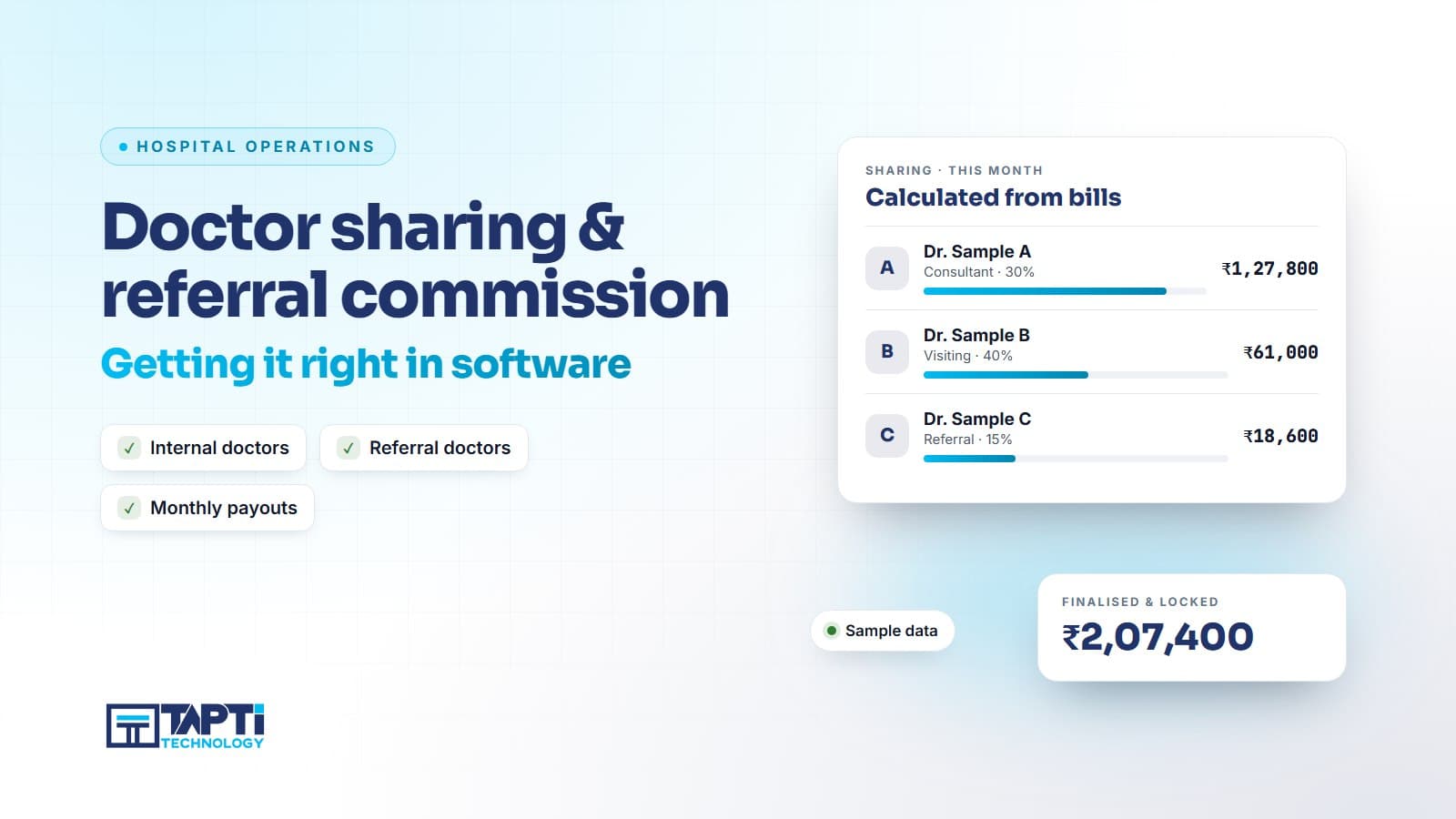
- Visiting consultant sharing — A consultant uses the hospital's facility; the hospital and consultant split each consultation / procedure on a pre-agreed percentage.
- Internal referral — Doctor A inside the hospital refers to Doctor B inside the hospital; B's revenue is partially shared with A.
- External referral — A clinic or GP outside the hospital refers a patient in; on certain services, a share is paid to the referrer.
Each of these has different rules, different rates, different downstream impacts on the bill, on the consultant's payout, and (importantly) on what the patient is told.
What good HMIS support looks like
Rates are configured per doctor, per service, not as a global default
Dr Sharma might get 60% on OPD consultations and 40% on ultrasound. Dr Mehta might get 50% on both. Globals don't work. The HMIS needs to store per-doctor-per-service overrides.
Sharing calculates at the moment of billing
When a patient is billed for an ultrasound that was referred by Doctor A and performed by Doctor B, the system should — at that moment, automatically — record:
- The hospital's share
- The performing doctor's share
- The referring doctor's share (if applicable)
No spreadsheet at month-end. The records are made as the bill is made.
Doctor payout reports are a button, not a project
At month-end, the accounts team should pick a doctor, a date range, and click "Doctor Sharing Report." Every share recorded against that doctor — referral, performing, consultation — should appear in a single PDF / Excel with line-item totals.
External referrers are tracked too
If your hospital pays GPs or clinics a percentage on referred patients, the same system should track them — by referrer name, with their cut on each applicable bill, summed monthly.
What goes wrong on paper
- Sharing percentages change verbally, never get updated in the spreadsheet
- One doctor's services get missed because they weren't tagged as "referral"
- Month-end reconciliation takes two days of accounts staff time
- Disputes happen because the doctor's count doesn't match the hospital's count
All of this disappears the moment sharing is computed at the moment of billing inside the HMIS.
Tapti's Doctor Sharing module
Tapti HMIS treats doctor sharing as a first-class workflow:
- Per-doctor-per-service rates, with effective-from dates so historical accuracy is preserved
- Shares calculated and recorded at the moment of billing — both for in-house consultants and external referrers
- One-click reports per doctor / per period
- Full audit trail of every share, including who edited what when
The result: month-end doctor settlements that used to take days now take minutes. Disputes drop to near zero because the numbers are visible and the trail is auditable.
If doctor sharing is the part of your hospital's finance that hurts most, ask for this in your demo specifically. Book a walkthrough — we'll model it for your doctor list and rates.