
On this page
Talk to any Indian hospital owner about cash flow, and TPA rejections come up within five minutes. The complaint is universal: "They reject for the smallest things. Re-submissions take weeks. Money is stuck."
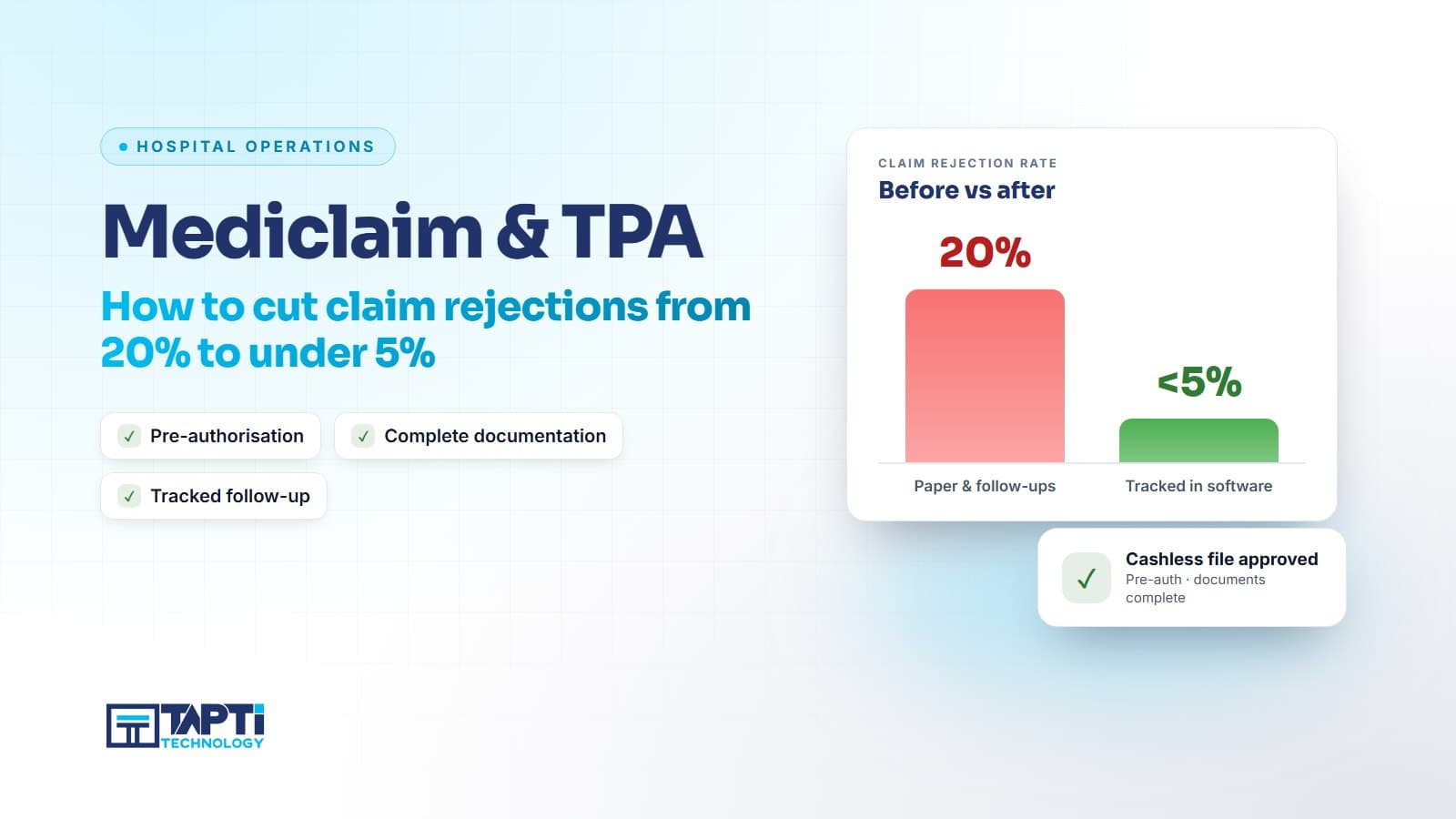
What's not universal — but should be — is the response. The hospitals running TPAs well have rejection rates under 5%. The rest sit at 15–25%. Same TPAs. Same patients. Different operations.
Why claims actually get rejected
Across hundreds of submissions we've reviewed, the top five rejection reasons are:
- Discharge summary missing a vital (BP, pulse, temperature on discharge day)
- Investigation report missing or unsigned
- Code mismatch between diagnosis and procedure (ICD vs CGHS / package)
- Pre-auth not matching final bill (line items added post-pre-auth without notification)
- Doctor signature / registration number missing from the discharge summary
None of these are TPA arbitrariness. They are real, fixable documentation issues. The HMIS is supposed to prevent them by design.
The four-step playbook
1. Pre-auth lives in the HMIS, not in a WhatsApp chat
The pre-authorisation request — including planned procedure, estimated bill, expected length of stay — should be generated by the HMIS, stamped with a tracking number, and tied to the patient record. WhatsApped scans get lost. HMIS pre-auths don't.
2. Mandatory fields enforced before discharge
The HMIS should refuse to print a discharge summary if any of these are missing:
- Doctor signature + MCI/IMA registration number
- Vitals at admission AND vitals at discharge
- All investigation reports attached
- Final diagnosis with ICD-10 code
- Procedure code matching the pre-auth
This single rule cuts rejections by half.
3. Any post-pre-auth addition triggers an enhancement request
If something is added to the bill after pre-auth (additional medications, an extra day, an imaging study) the HMIS should flag it and generate a TPA enhancement request before the patient is discharged. Not after the rejection arrives three weeks later.
4. Aging dashboards, not aging files
Every pending claim should be visible on a single dashboard with its TPA, its age, its expected response date, and its assigned executive. Once a claim crosses its expected response date by 48 hours, it should auto-escalate.
What Tapti HMIS does specifically
Tapti's Mediclaim module enforces all four steps above as the default workflow — not as optional features. The pre-auth screen captures the full planned bill; the discharge summary screen blocks save if mandatory fields are missing; any post-pre-auth additions trigger an enhancement workflow automatically.
Hospitals onboarding to Tapti see their rejection rates drop within the first two billing cycles. Not because the TPAs got nicer — because the documentation stopped giving them excuses.
See it
If TPA cash flow is your biggest operational pain, this is the demo to ask for. Book a 30-minute walkthrough focused on the mediclaim & TPA workflow — we'll show you how each rejection-prevention check is wired in.